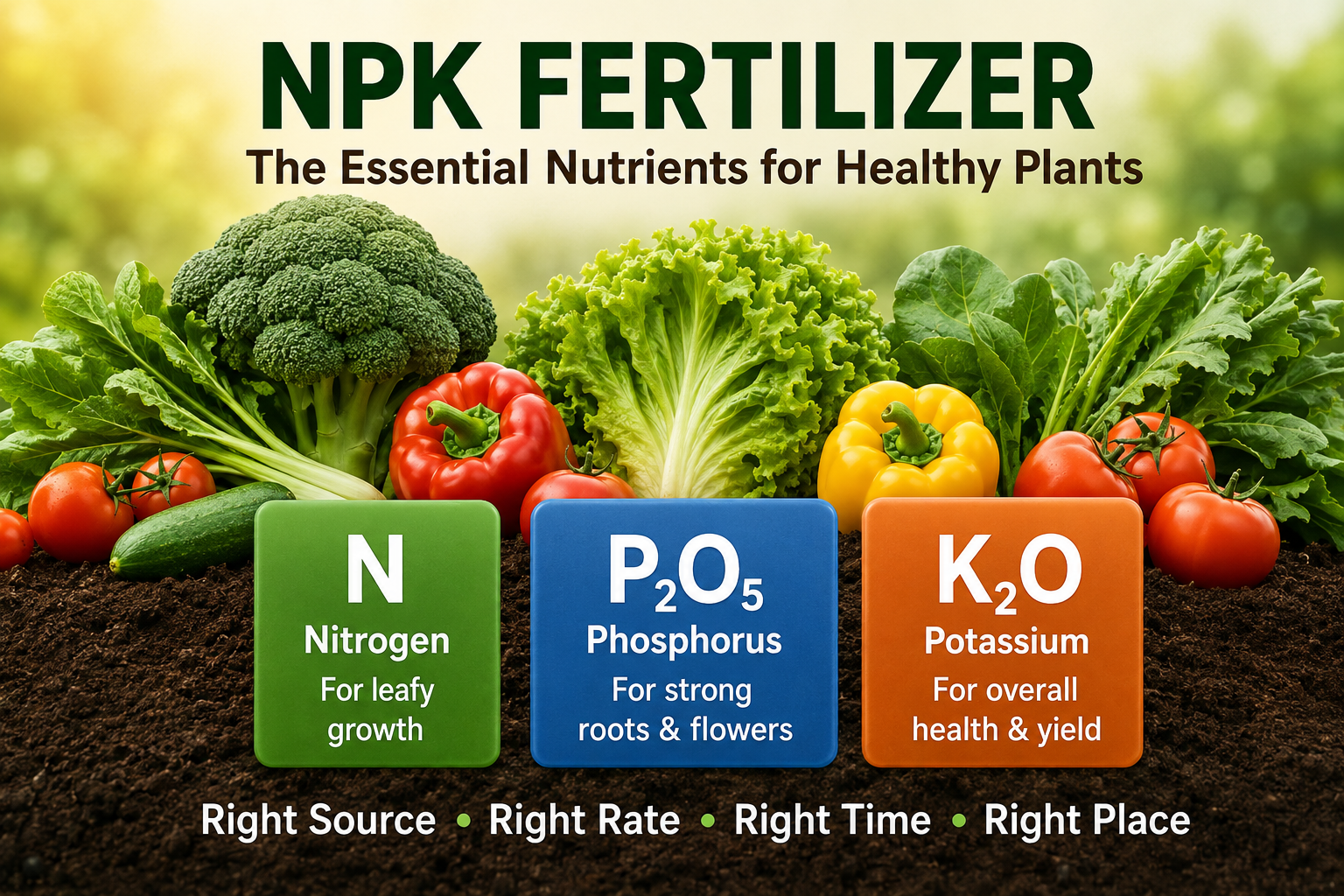
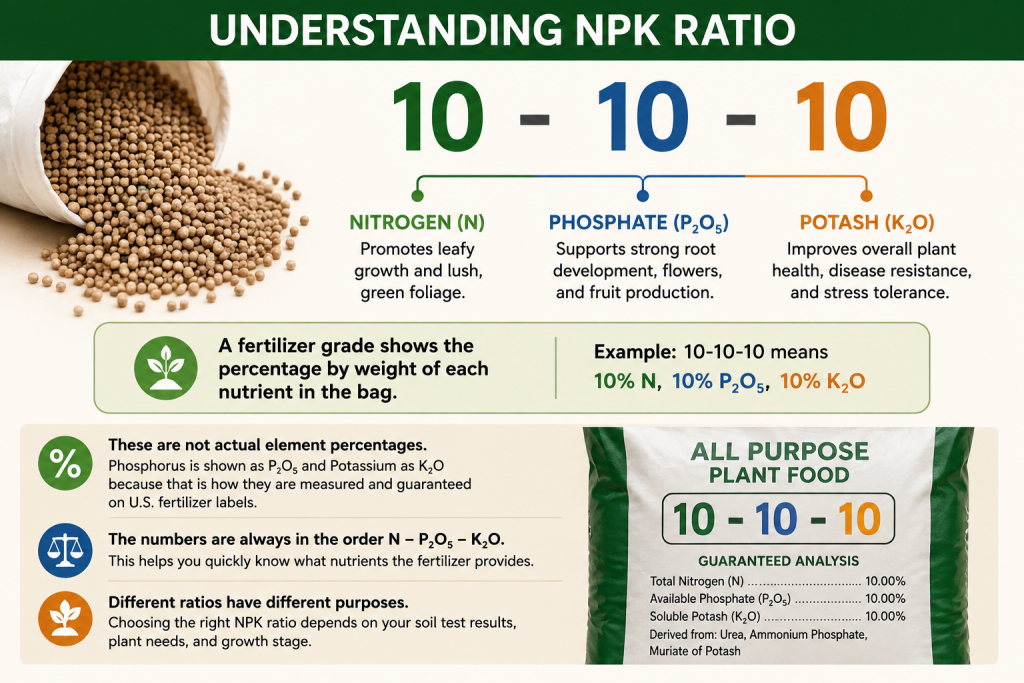
Understanding N–P–K (Nitrogen–Phosphorus–Potassium): Every fertilizer is labeled with three numbers (the grade), such as 10-10-10 or 20-10-10. These represent the percentage by weight of nitrogen (N), phosphate (P₂O₅), and potash (K₂O) in the mix. For example, a 10-10-10 fertilizer contains 10% N, 10% P₂O₅, and 10% K₂O by weight. This means 10 pounds of 10-10-10 supply 1.0 lb of N, 1.0 lb of P₂O₅, and 1.0 lb of K₂O. The numbers are sometimes called ratios (e.g. 1:1:1) but always refer to percentages. A balanced garden fertilizer often has equal or similar numbers (like 10-10-10), while specialty blends might emphasize one nutrient (e.g. 5-10-10 has twice as much P as N, useful for bulbs/roots.
Calculating Nutrient Amounts: To know how much fertilizer to apply, convert your soil test or crop recommendation into weights. First, decide the total pounds of each nutrient (N, P₂O₅, K₂O) needed per area (often given as lb/1,000 ft² or lb/acre). Then use the fertilizer grade to find how many pounds of fertilizer supply that nutrient. For example, if a lawn needs 1.0 lb of N per 1,000 ft² and you have 10-10-10 (10% N), you divide: 1.0 lb ÷ 0.10 = 10 lb of 10-10-10 per 1,000 ft². Conversely, a 20-10-10 (20% N) fertilizer is twice as concentrated in nitrogen, so you’d only use 5 lb to get 1 lb N (because 5 × 0.20 = 1.0). In general, higher-grade fertilizers require smaller quantities. For example, 10 lb of 5-10-10 supplies 0.5 lb of N, 1.0 lb of P₂O₅, and 1.0 lb of K₂O per 1,000 ft². If you switch grades, adjust the weight accordingly: a 10-20-20 has the same N:P:K ratio as 5-10-10 but is twice as concentrated, so use only half as much.
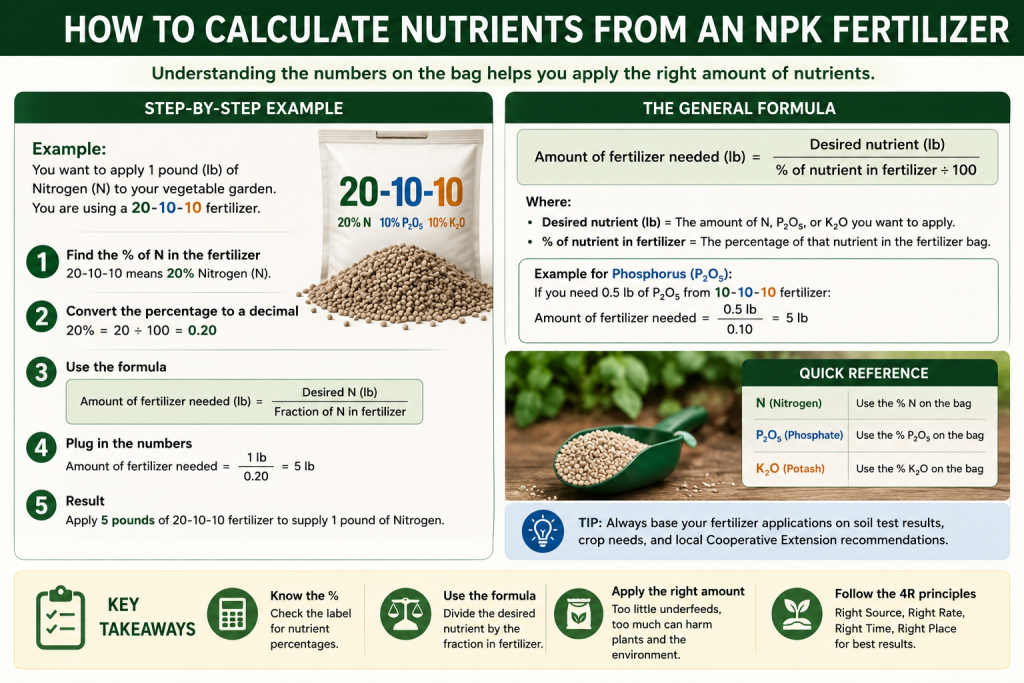
A step-by-step calculation example: if a soil test says “apply 1.5 lb N, 0.5 lb P₂O₅, 0.5 lb K₂O per 1,000 ft²”, and you only have 16-4-8 fertilizer, then 16-4-8 has 16% N. To get 1.5 lb N, you need 1.5 ÷ 0.16 = 9.4 lb of 16-4-8 per 1,000 ft². That amount will also supply 9.4×0.04=0.38 lb P₂O₅ and 9.4×0.08=0.75 lb K₂O. You’d compare these to the recommended 0.5 lb P₂O₅ and 0.5 lb K₂O, realizing this blend gives slightly less P and more K than needed; you might supplement with a low-P or high-P source accordingly. (Online calculators from land-grant extensions can automate this kind of fertilizer substitution.)
The table gives examples of common grades and typical uses:
| Fertilizer Grade (N–P₂O₅–K₂O) | Description / Typical Uses |
| 10-10-10 | Balanced, all-purpose; good for general vegetables and mixed beds. |
| 5-10-10 | Phosphate-heavy; supports root crops/bulbs and flowering plants. |
| 16-4-8 (High-N) | Lawn and heavy-feeders; early-season nitrogen boost for grass and leafy greens. |
| 0-20-0 (Superphosphate) | Root and bloom development; use when soil is low in phosphorus. |
| 3-4-4 (Low-N slow-release) | Low-N mixes often provide slower, steadier feeding; useful for containers or long-season crops. |
Note: These are fertilizer-grade examples, not universal application recommendations.
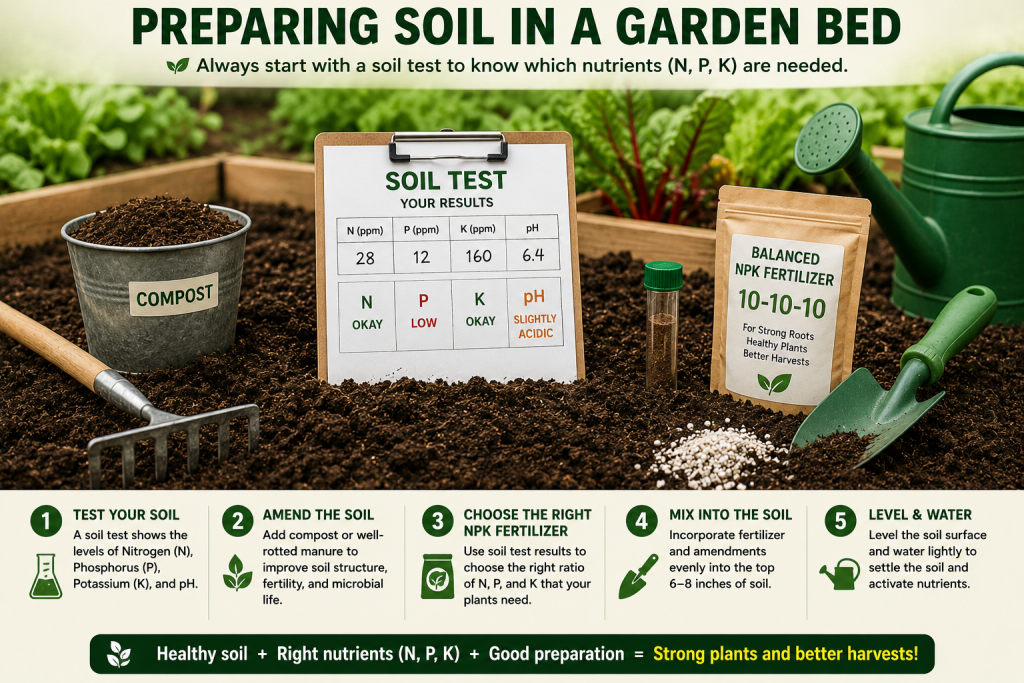
Selecting Fertilizer by Soil Test and Crop: Always begin with a soil test. A university or commercial lab report will give you nutrient levels (especially P and K) and often recommend fertilizer rates. Soil tests measure plant-available nutrients, not total nutrients. Use those results and your crop’s needs to choose a fertilizer. For example, if soil P and K are already very high, you might only need nitrogen. Consult local resources: Because soils and climate vary by region, use local Cooperative Extension guidelines for crop-specific fertilization
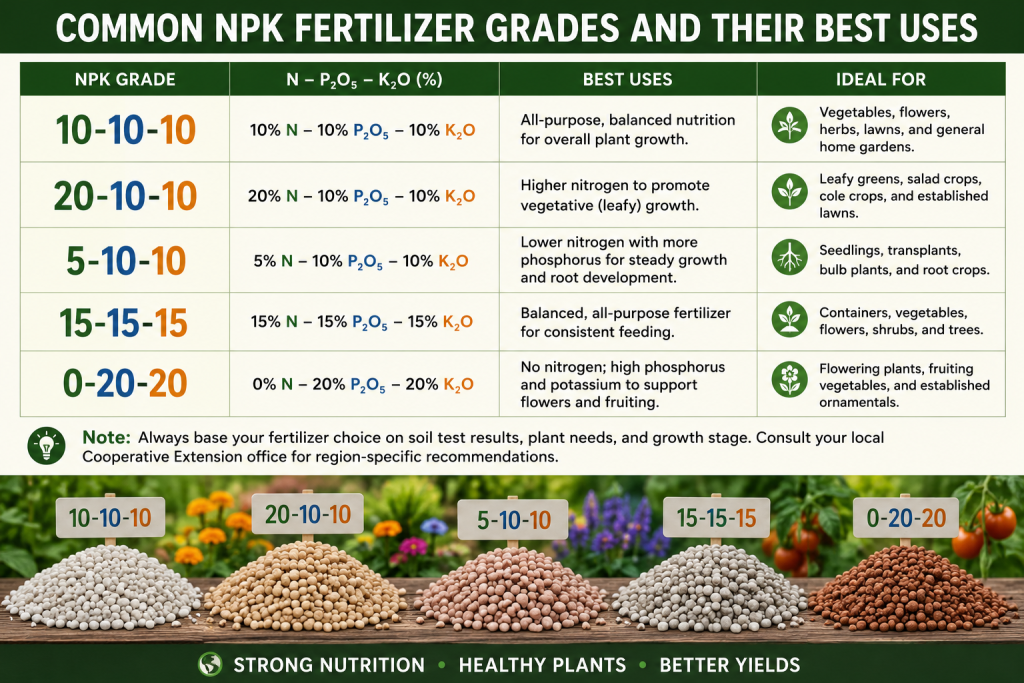
Common N-P-K Fertilizer Mixes and Uses: Home-gardeners often use general-purpose “balanced” fertilizers (like 10-10-10 or 5-10-5) for mixed beds. A balanced 10-10-10 promotes even growth of foliage, fruits, and roots. For lawns and grass, higher-nitrogen mixes (e.g. 16-4-8) are common to encourage green growth early in the season. Bulb and root crops (like potatoes) often do well with formulas richer in phosphorus (for roots), such as 5-10-10. In contrast, flowering annuals or fruiting vegetables may use somewhat higher P and K to support blooms and fruit, while excess N can make too much leafy growth.

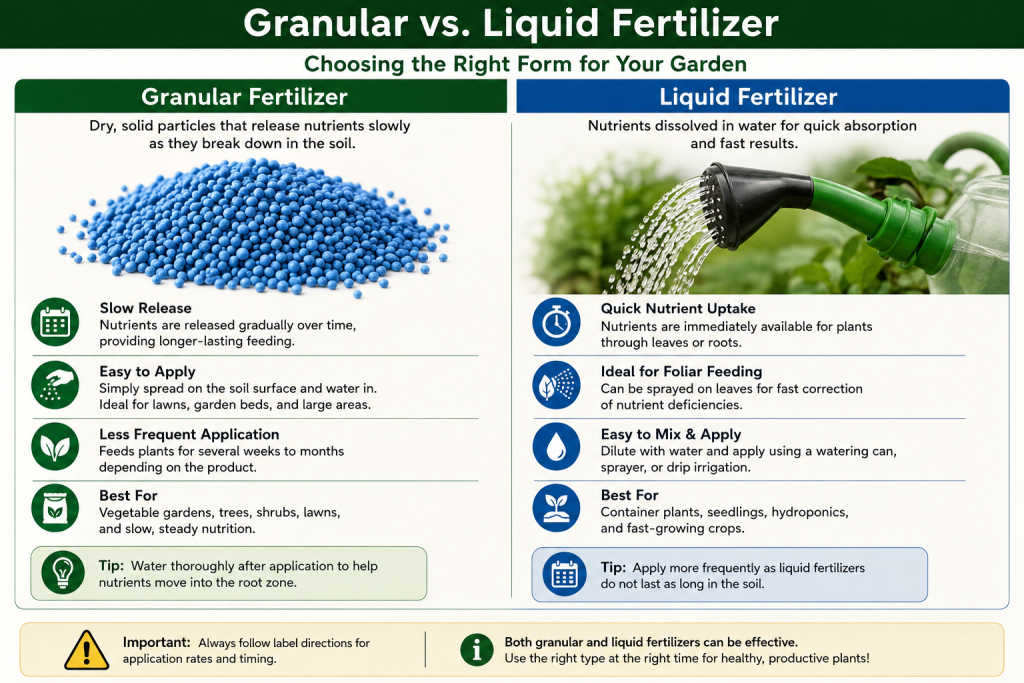
Granular vs. Liquid; Organic vs. Synthetic: Fertilizers come as dry granules or liquids. Granular fertilizers are solids (often pelletized or coated) that are broadcast or incorporated into soil. Liquids (or water-soluble powders) can be mixed in water for drip or foliar application. Liquids tend to act faster and can be convenient for fertigation, but they often cost more per unit nutrient. Many gardeners choose granules for pre-plant soil amendment and liquids for mid-season foliar feeding or hydroponics.
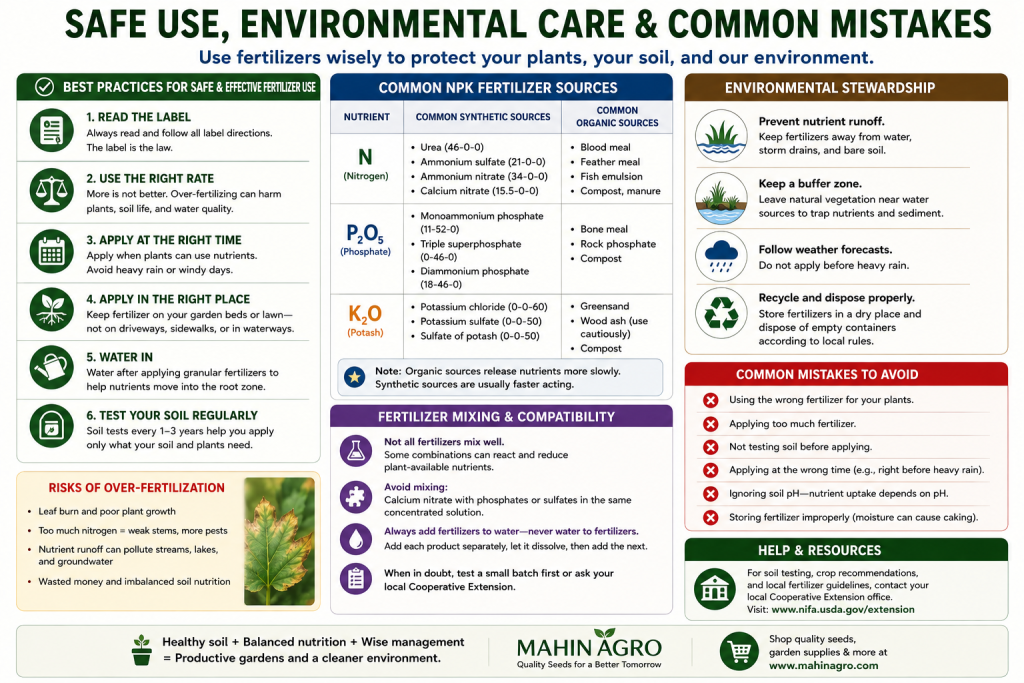
Source of nutrients also matters. Synthetic fertilizers (urea, ammonium nitrate, triple superphosphate, muriate of potash, etc.) are highly concentrated (e.g. urea is 46-0-0, triple superphosphate ~0-46-0). Organic fertilizers (manures, compost, bone meal, kelp, blood meal, etc.) supply nutrients more slowly and at lower percentages. Organic sources improve soil health but release nutrients gradually and may not meet large crop demands quickly. Choose based on your goals.
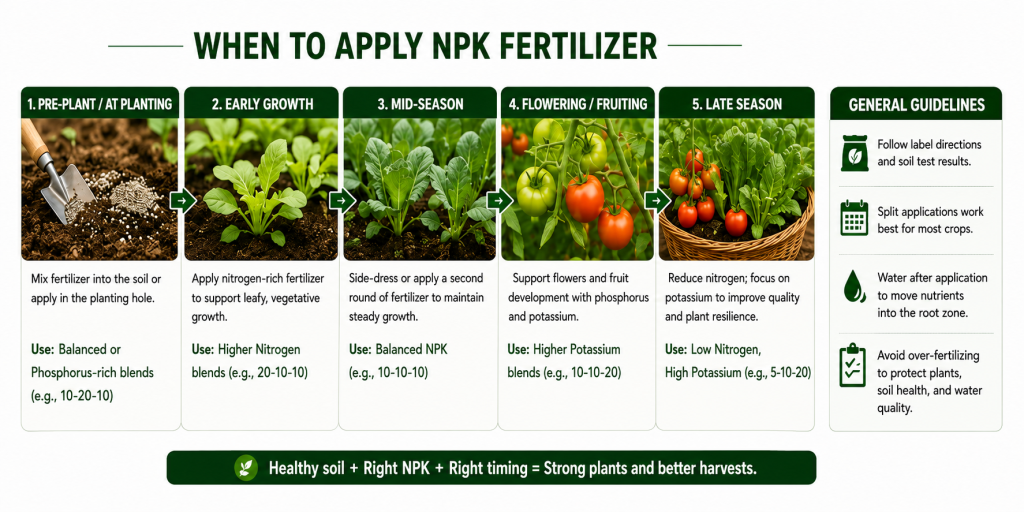
Timing (Pre-Plant vs. In-Season): Many fertilizers are applied before or at planting to supply baseline nutrients. Incorporating the right fertilizers into the soil before seeds or transplants go in helps root development and smooth early growth. During the season, side-dressing or foliar feeds can top off nitrogen or other nutrients as needed. For example, it’s common to apply a high-nitrogen side dress to corn or leafy crops when they reach knee-high stage. Always match application timing to plant need: high N early for leafy growth, more K and P when setting blooms or fruiting. (Don’t apply heavy doses just before heavy rain – nutrients may wash away. If weather is unusually wet or crops look deficient, a light supplemental feeding may be used.)
Mixing Fertilizers Safely: Do not assume all fertilizers can be mixed indiscriminately. While many products are chemically compatible, some combinations form insoluble salts or clog sprayers. For liquid mixes, always consult a compatibility chart or test a small batch in a jar for precipitates. For dry blends, particle sizes should match to spread evenly. When in doubt, select a single “balanced” or “complete” fertilizer with the right grade for your needs.
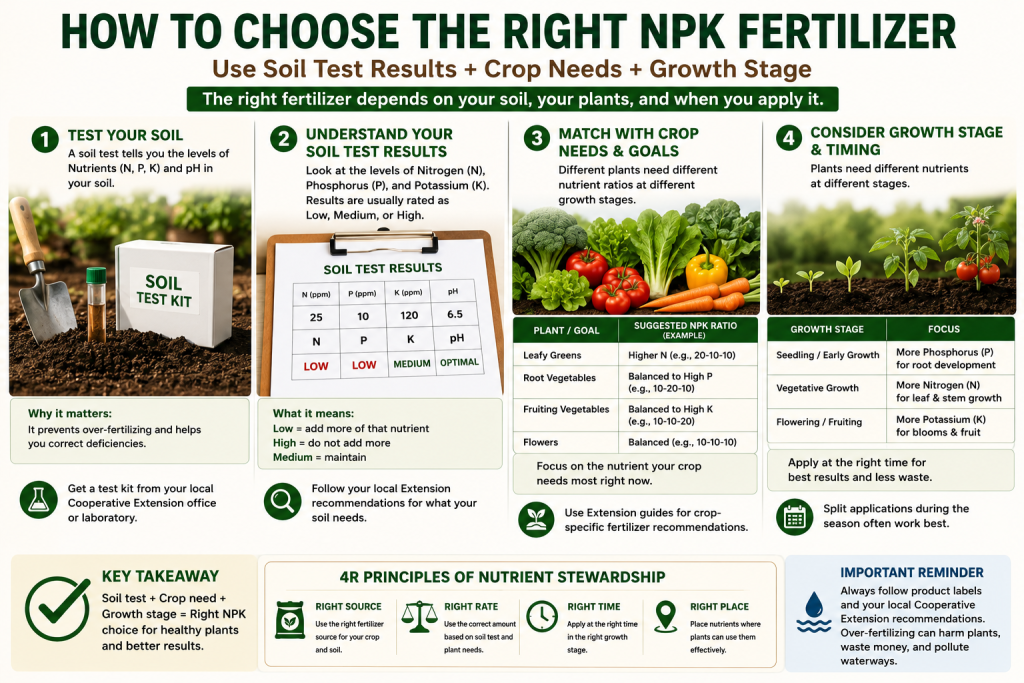
Avoiding Over-Fertilization & Runoff: More fertilizer is not better. Over-applying NPK can burn plants, waste money, and pollute water. Symptoms of excess fertilizer (especially salts or high ammonia) include brown leaf edges, wilting, or stunted growth as roots are damaged by salt injury. To prevent this, use only recommended rates and water in dry fertilizers immediately. Implement the 4R nutrient stewardship principles: use the Right Source (a fertilizer matched to crop needs and soil conditions), Right Rate (based on soil tests and yields), Right Time (at growth stages when plants need it most), and Right Place (where roots can access it). Following the 4Rs not only optimizes plant growth but also minimizes environmental losses.
Frequently Asked Questions:
Q: What do the numbers on fertilizer bags (e.g. 10-10-10) actually mean?
A: The three numbers are the fertilizer grade: they show the percent by weight of nitrogen (N), phosphate (as P₂O₅), and potash (K₂O) in the bag. So 10-10-10 means 10% N, 10% P₂O₅, 10% K₂O. These are not literal ratios but concentrations. A 10-10-10 mix is balanced (equal parts), whereas something like 20-10-5 (high nitrogen) is 20% N, 10% P₂O₅, 5% K₂O.
Q: How do I pick the right N-P-K ratio for my vegetable garden?
A: Start with a soil test to see existing nutrient levels. If soil P and K are ample, you may only need a high-N fertilizer. If soil is low in P or K, choose a blend richer in those elements. Also consider the crop: leafy greens like more N, root and fruit crops need a balance of P and K for strong roots and fruits. For most home veggies, a balanced 5-10-5 or 10-10-10 is a safe all-purpose choice, adjusting as needed per test.
Q: Can I mix two different fertilizers together?
A: Mixing different products is risky unless you check compatibility. Some fertilizers simply dissolve and mix, but others can react (especially phosphates with alkaline materials) and form sludge. As a rule, avoid mixing dry and liquid fertilizers in the same application unless labeled for that purpose. Usually it’s simpler to apply each fertilizer separately, according to label rates, rather than blending them.
Q: Can I apply too much fertilizer?
A: Over-fertilization can burn plants and harm soil and water. Excess salts from fertilizers pull water from roots and leaves, causing browning, wilting, or stunted growth. Also, extra fertilizer often runs off into waterways, causing algae blooms. Always follow recommended rates and don’t “feast and famine” – it’s better to fertilize lightly and repeat if needed.
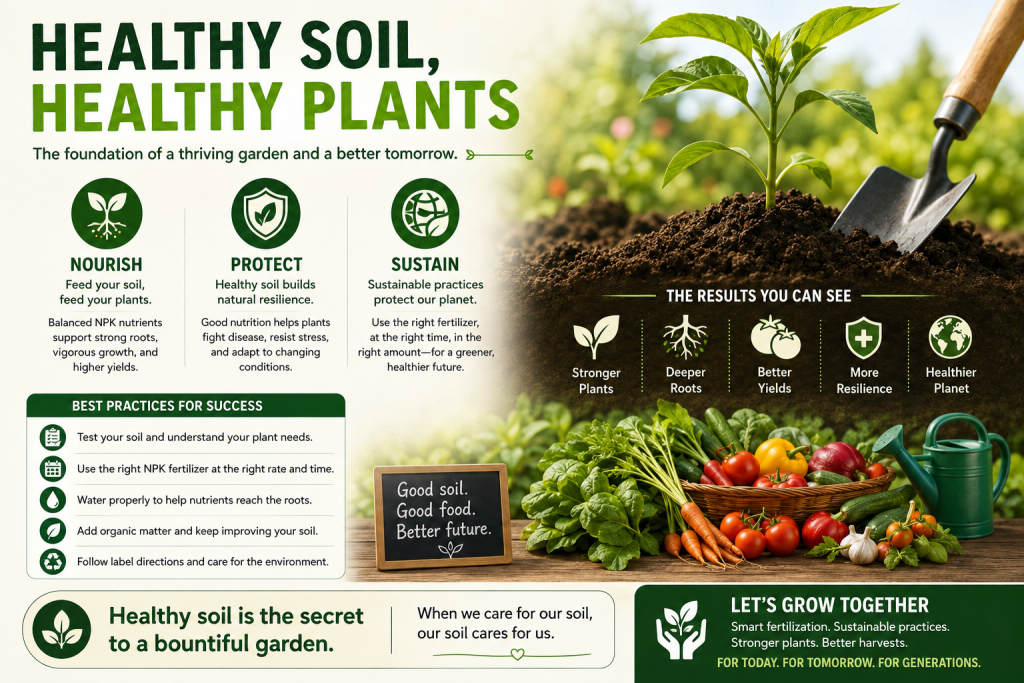
Choosing and using N-P-K fertilizers correctly is essential for a healthy garden and a healthy environment. By understanding fertilizer grades, calculating applications from soil tests, and following best practices (4R principles), home gardeners can feed plants efficiently and safely. For specific recommendations, contact us. At Mahin Agro, we offer a variety of high-quality seeds and fertilizer products tailored for American gardens. Contact us for guidance – we’re here to help you grow healthy plants the right way!